A marketing team uses AI to draft a weekend promotion. The post goes live on Friday evening. The price is wrong, and the copy promises a benefit nobody approved. By Saturday morning, a customer has screenshotted it and shared it in a group chat, asking which version is true.
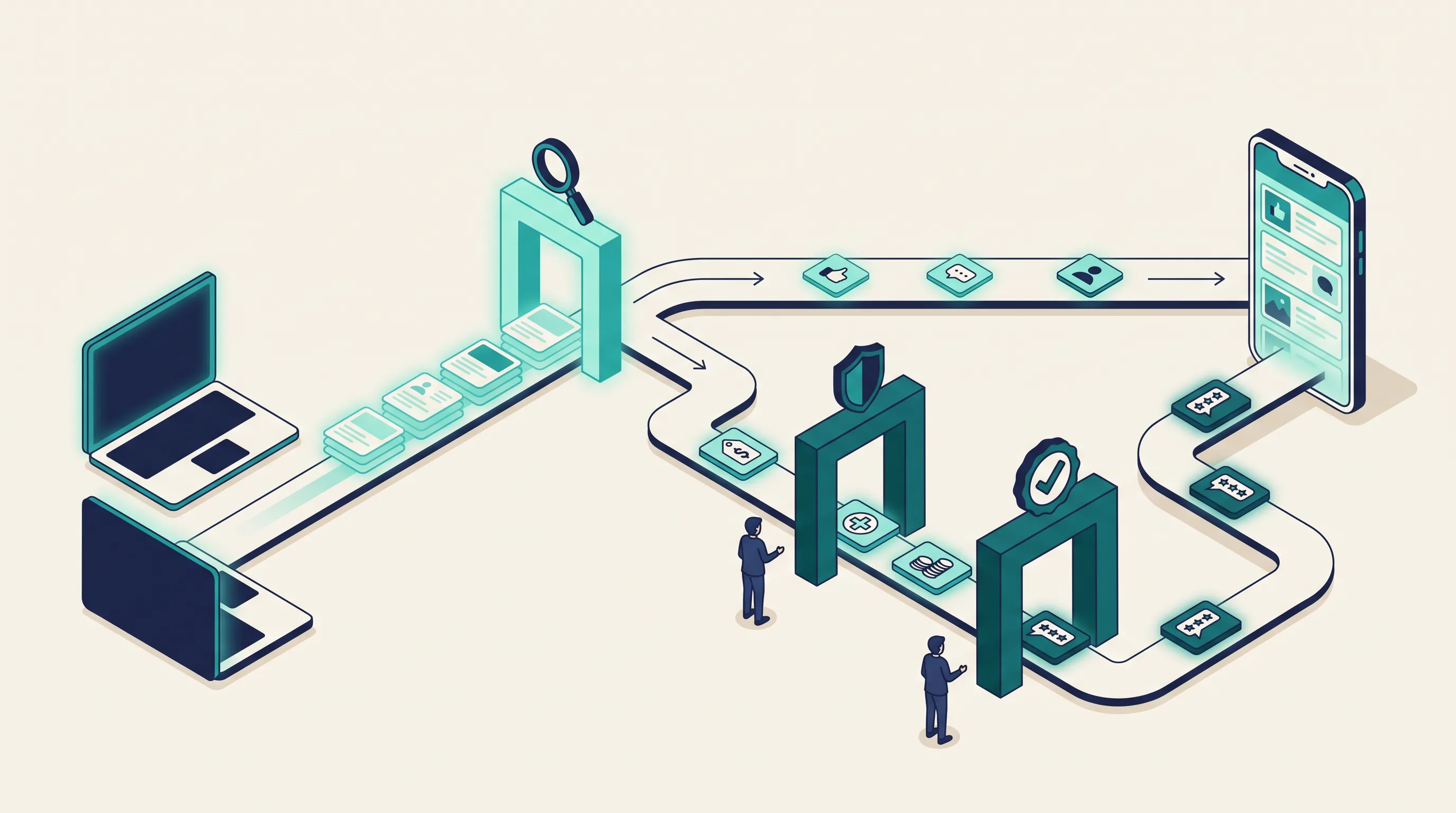
AI-assisted workflows can speed up some content-production tasks. A study of semi-automated SEO content production in two industries found potential efficiency gains, while emphasising that human editing remains essential. Without checks, faster production can also move mistakes closer to customers.
What the research says, and what it doesn't
The studies below measure different things, and most are not specific to marketing.
In the 2025 University of Melbourne and KPMG online survey, Trust, attitudes and use of artificial intelligence: A global study 2025, 46% of respondents were classified as willing to trust AI across the study's randomly assigned use cases. The survey ran from November 2024 to mid-January 2025, with 48,340 respondents in 47 countries and jurisdictions. The report notes that some country samples have representativeness limitations, so these results should not be read as a census of everyone in those countries. This is general AI trust, not a measure of trust in AI-generated advertising or brand content.
The same study looked at work. Among 32,352 respondents working full- or part-time, 66% said they sometimes, often or very often relied on AI output at work without evaluating the information, and 56% said they sometimes, often or very often made mistakes in their work due to AI (full report). These are self-reported workplace experiences. They show why review matters, but they do not measure marketing teams or public-facing content.
Marketing-specific evidence comes from the US. In an IAB and Sonata Insights survey fielded from October 2025 to January 2026, 82% of 104 ad executives believed consumers felt very or somewhat positive about AI-generated ads. Among 505 US consumers who had engaged with ads (Gen Z aged 16 to 27 and Millennials aged 28 to 43), 45% said they themselves felt very or somewhat positive. The questions differed: executives estimated consumers' views, while consumers reported their own. In a separate question, 35% of 502 consumers said clear disclosure of AI use would make them more likely to pay attention. It ranked third among the listed factors. That is stated intention, not proof that disclosure lifts actual attention or sales.
What this means in our markets
The global study also found that surveyed respondents in some emerging economies, including Nigeria, Saudi Arabia and the UAE, reported greater willingness to trust AI in general. That does not tell us whether people trust AI-generated marketing. Our view is that broad openness to AI is not permission to publish unverified claims.
Two hypothetical examples show where this can go wrong:
A Lagos fintech's AI-written ad states a promised financial return that compliance never approved.
A Muscat hotel's AI-generated room images don't match what guests find on arrival.
Data matters too. Before putting customer data into an AI tool, identify which privacy, sector and platform rules apply in that jurisdiction. Examples include Nigeria's Data Protection Act, 2023; Ghana's Data Protection Act, 2012 (Act 843); Saudi Arabia's Personal Data Protection Law; and the UAE's federal Personal Data Protection Law. The rules can vary by jurisdiction and sector. This is general information, not legal advice.
Four trust risks, and the guardrail for each
1. Accuracy. Generative AI can confidently present false or erroneous content. The US National Institute of Standards and Technology calls this "confabulation" in its Generative AI Profile. In marketing, that might look like an outdated price, an invented statistic or a claim your product can't support. Guardrail: a person checks every fact, number, offer and claim before it goes live.
2. Voice and cultural fit. A caption can be grammatically correct and still sound nothing like you. In multilingual markets, a correct translation can still miss idiom, tone or context. Guardrail: a written brand voice guide, and a reviewer familiar with the audience and the language.
3. Data and privacy. Teams may be tempted to paste customer details into an AI tool to personalise a message. Guardrail: use customer data only in tools and workflows approved for that purpose, with clear rules on what data can go where, and consent where it's required.
4. Authenticity. Generative AI can produce highly realistic images, voices and video (NIST). Used carelessly, they can mislead customers about what they're buying or who stands behind a product. Guardrail: a disclosure policy for synthetic people, voices and realistic images. This is our recommended practice, not a statement of what every law requires. One line is not negotiable: no fake testimonials, reviews or customers, disclosed or not.
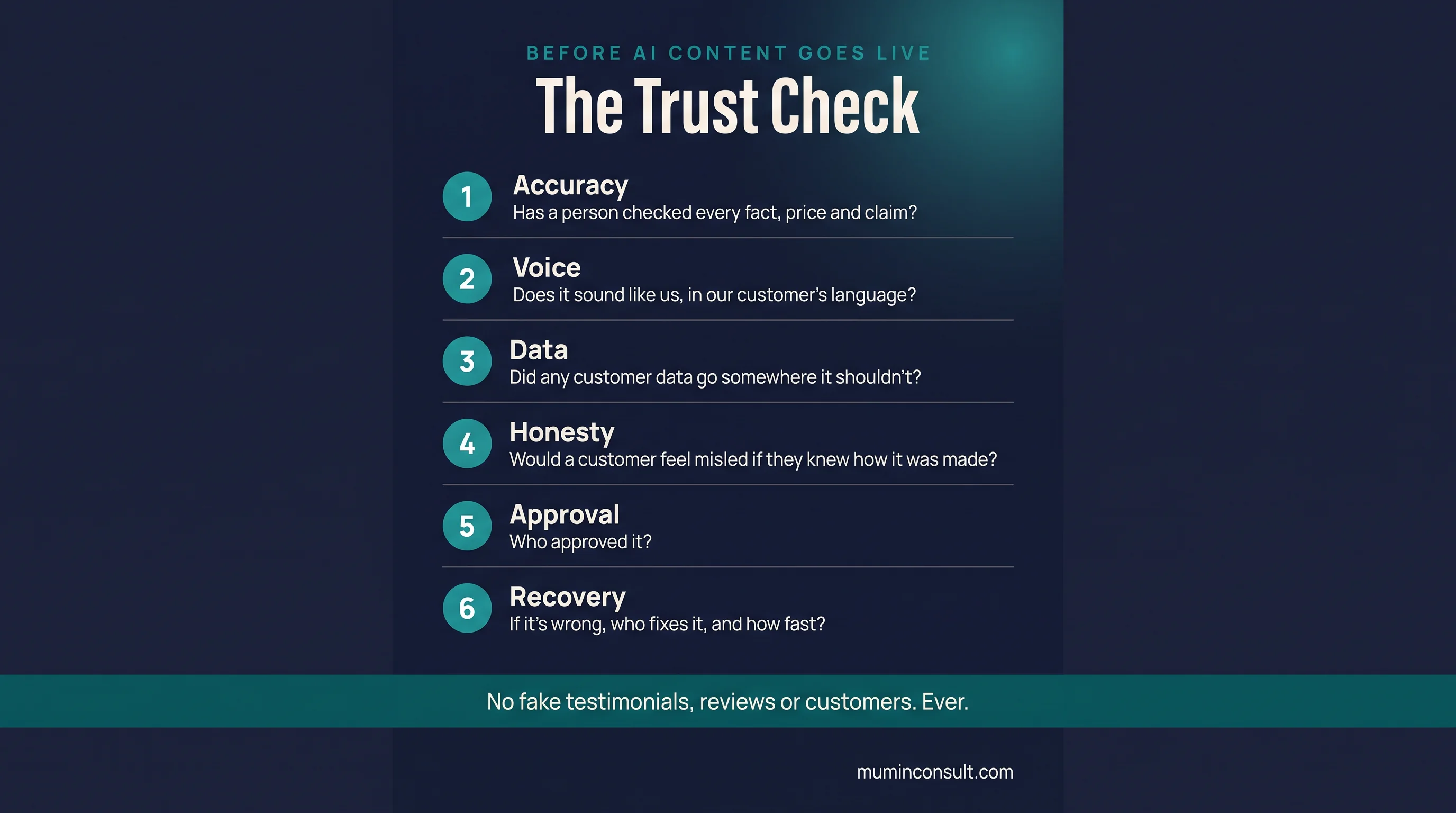
The Trust Check: six questions before AI-assisted content goes live
- Accuracy: Has a person checked every fact, price and claim?
- Voice: Does it sound like us, in our customer's language?
- Data: Did any customer data go somewhere it shouldn't?
- Honesty: Would a customer feel misled if they learned how it was made?
- Recovery: If it's wrong, who fixes it, and how fast?
Set two review tiers:
Basic check: everyday, low-risk content such as social captions and routine updates. One person runs the six questions.
Basic check plus specialist approval: anything involving prices, health, finance, legal terms or customer testimonials. Someone with the right expertise signs off before it publishes.
What a basic check looks like in practice (hypothetical): an editor reviewing an AI-drafted promotional post opens the current price list and confirms the price matches. They check that the offer's end date is right, and they confirm who owns any claim in the copy, such as "fastest delivery in town," and whether there is evidence for it. If there isn't, the claim comes out. They read the caption aloud once to test the tone, then record who approved the post and when.
Write the tiers down and name the approvers. Build the checks in before content goes live, not after a customer finds the problem.
Where to start
Start with the posts, ads and messages that mention prices, promises or real customers. Test the Trust Check on a small batch of your highest-risk content, note where it catches problems, then adjust the process.
Mumin connects marketing strategy, execution and measurement so businesses can make better decisions about what to build, improve and stop. If you want an outside view of where your marketing stands, book a discovery call about the Mumin Audit.