Picture a quarterly review at a growing business. Over the past year, the marketing team has switched on AI features across its software and ad platforms. The team can produce content and campaign variations faster, and the reports have never been fuller.
Then the CEO asks a simple question: what did all of this do for the business?
The room goes quiet. Nobody set out to measure the work, so the team can't yet say how much value it created. It can show more output, but not a credible link between that output and business value.

What the research actually says
Large surveys measure AI use and reported financial impact separately. That distinction is a reason to measure what a specific marketing workflow contributes, rather than infer value from activity alone.
In McKinsey's 2026 State of AI survey, 37% of respondents attribute at least some positive EBIT impact to AI use, about the same share as last year. EBIT means earnings before interest and taxes. This is a self-reported, enterprise-level measure. It does not calculate the return of an individual marketing campaign.
In the same survey, respondents most often attribute AI-related revenue gains to the combined marketing and sales function. That is a frequency finding, not a measure of the gains' size or proof that AI caused them.
McKinsey defines AI high performers as respondents who attribute an EBIT impact of 5% or more to AI use and say their organizations have seen "significant" value from AI. Among these respondents, nearly three-quarters say they have fundamentally redesigned workflows because of AI, compared with about one-quarter of other respondents (source).
This does not prove that redesign caused the reported impact. It does make the workflow itself a useful place to investigate.
What to check in your own market
A separate GCC survey, fielded in August and September 2025, used a different and stricter definition of value. Its result is not directly comparable with the global 37% figure above.
McKinsey and the GCC Board Directors Institute surveyed 139 senior executives and board directors across the six GCC states. Only 11% of respondents categorized their organizations as "value realizers": organizations that use AI in at least one function, are scaling or have scaled it, and attribute at least 5% of earnings to AI (source).
These are self-reported answers, not audited results. The sample is not a benchmark for every GCC country or business.
The evidence that matters most is inside your own business. Two hypothetical examples:
- An Accra retailer uses AI to produce more social content. It should check whether that content brings in qualified buyers, not just likes.
- A Riyadh B2B firm uses AI to draft sales follow-ups. It should test whether more qualified opportunities actually move forward.
In both cases, the answer depends on things only the business can check: the languages its customers use when searching, comparing and buying; its channel mix; the data it actually has; the length of its sales cycle; its team's capacity; and what each tool really costs once currency, taxes and usage fees are included.
Four failure modes to check, and the fix for each
1. Buying the tool before defining the job. A subscription bought simply because "everyone is using it" may start without a defined outcome or baseline to justify the cost. The fix: Before you buy, finish this sentence: "This will help us do X, which should improve Y."
2. Adding AI to a weak workflow. If your campaign process already suffers from vague briefs, slow approvals and messy handoffs, AI can simply speed up the mess. The fix: Map one workflow from brief to delivery, including its inputs, handoffs and checks. Redesign it around what AI does well, then test it.
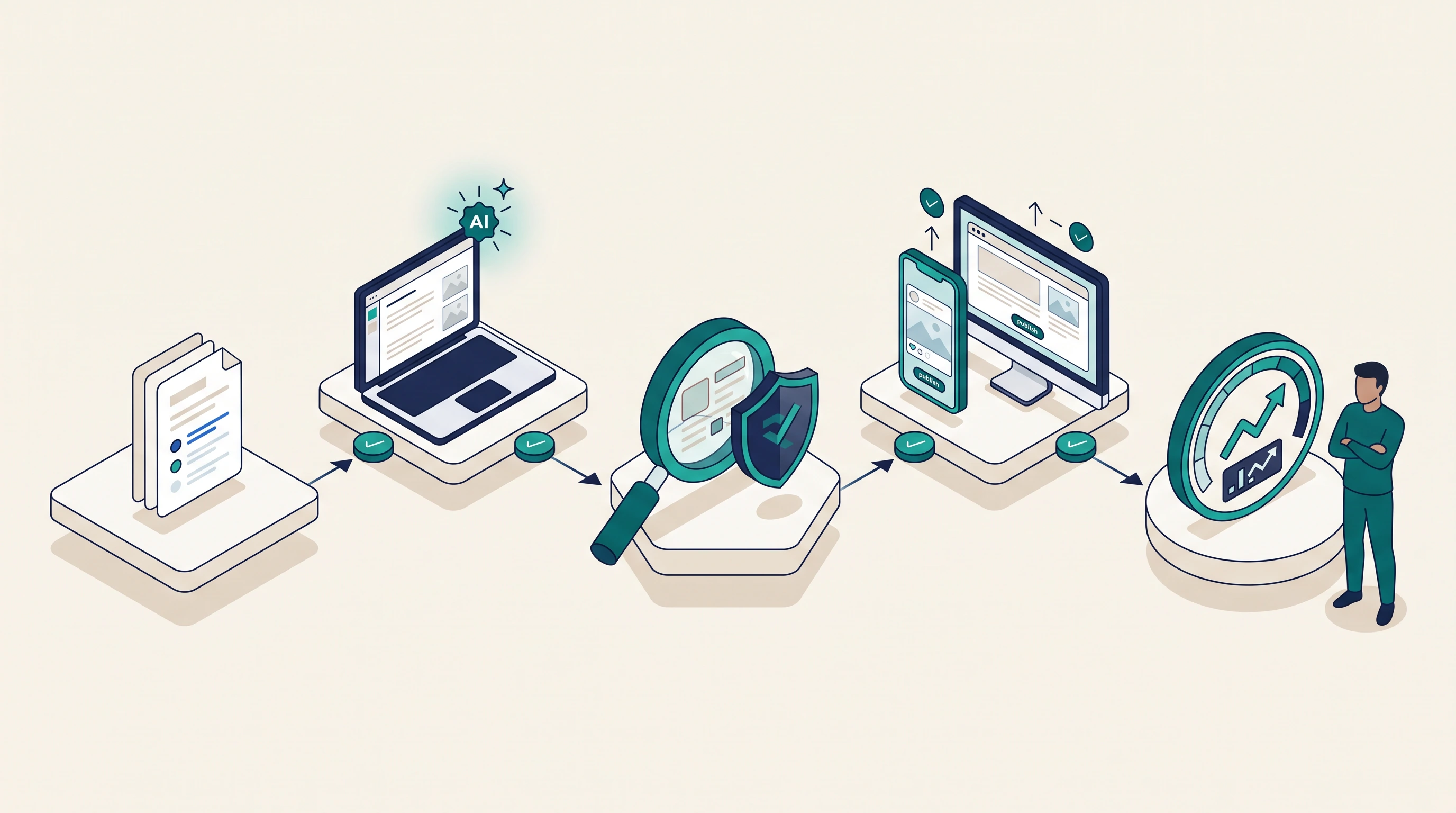
3. Counting activity instead of outcomes. Posts published and hours saved are useful early signals, but they aren't proof of value. Time saved is capacity, not automatically a saving. It creates business value when the freed time is productively redeployed, reduces costs, or advances another defined outcome. The fix: Connect each workflow to an outcome: qualified leads, contribution margin, retention, or a clear operational benefit.
4. No owner, no controls. When responsibility isn't assigned, reviews can fall through the cracks and quality problems may go unnoticed. The fix: Name one accountable owner and set a review date. Agree checks for approval, privacy, accuracy and brand standards.
The five-question AI value test
Run this test on a workflow, not a tool, because one workflow often relies on several tools.
1. Outcome and baseline: What marketing outcome should this workflow improve, and where did it start?
2. Contribution: What evidence suggests AI contributed to the change, over what period, and what else changed at the same time?
3. Ownership: Who owns the outcome, the quality checks and the next review?
4. Full cost: What does it really cost, including setup, integration, review time, rework, subscriptions and usage fees?
5. Next decision: Retain and measure, redesign and test, or retire it carefully. Before cancelling anything, check data exports, integrations and automations.
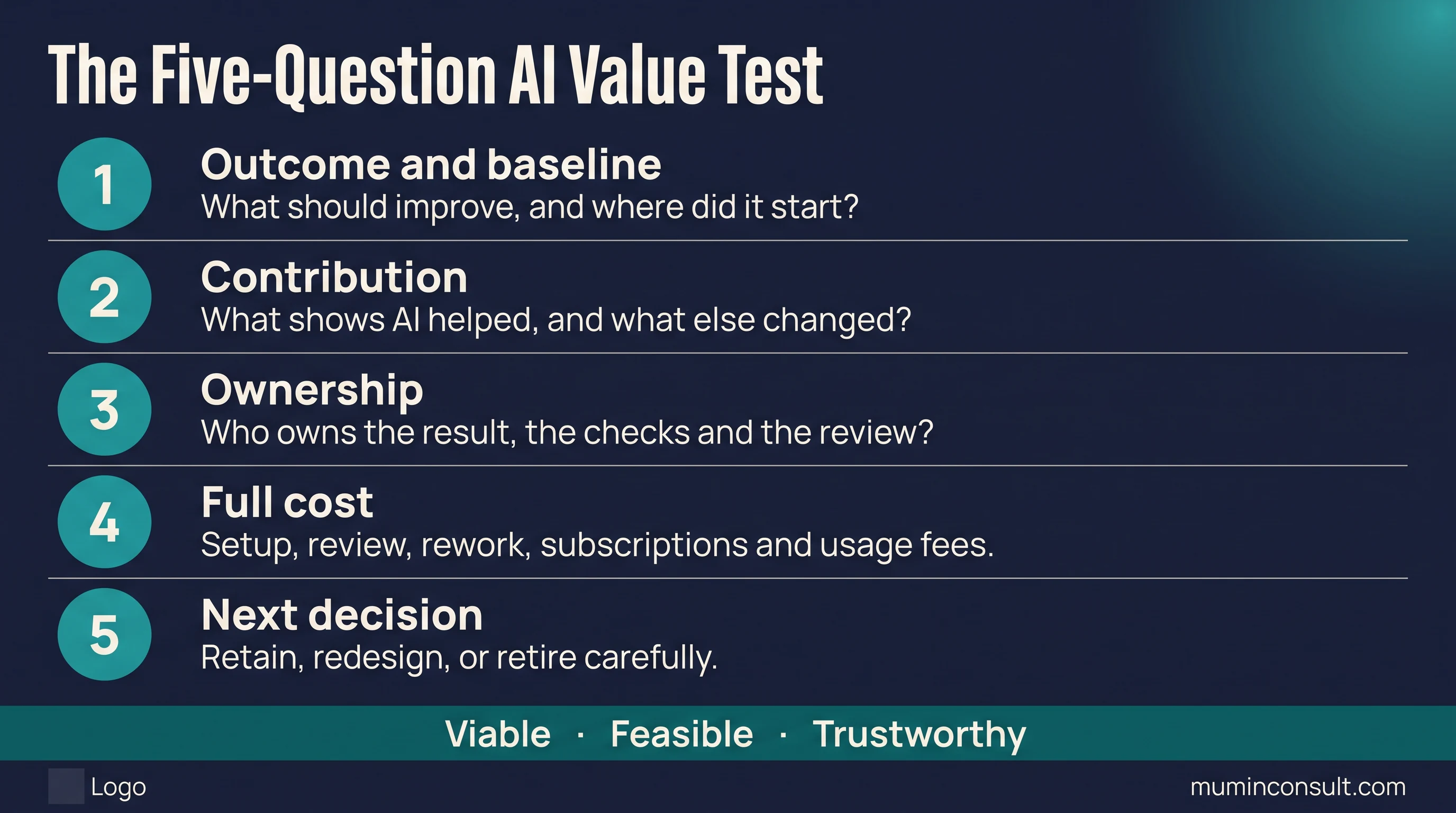
Before adding any new AI use case, apply three filters:
Viable: Is the expected benefit worth the full cost?
Feasible: Do you have the people, data, integrations and capacity to run it?
Trustworthy: Can it meet your standards for accuracy, privacy, permissions and brand, with human approval where needed?
A worked example (hypothetical): AI-assisted landing pages
Primary measure: cost per qualified lead, using the same definition of a qualified lead before and after the change.
Guardrails: lead quality and content accuracy, so that lead volume can't rise while quality falls.
Comparison: where you can, compare similar audiences under similar traffic conditions. If a comparable group isn't feasible, a before-and-after comparison can be a practical fallback, but state its limits plainly. Either way, check whether traffic mix, media spend or seasonality also changed.
A baseline gives you a reference point, not proof of cause. Be clear about what the evidence can and cannot show.
You can answer these five questions and set up the test this week. A real answer takes a review period that matches your sales cycle.
Where to start
You don't need another AI tool to begin. You need one workflow, one owner, a baseline and an honest test. Pick the workflow tied to the most meaningful measurable business outcome, run the five questions, and decide what to keep, fix or stop.
Mumin connects marketing strategy, execution and measurement so businesses can make better decisions about what to build, improve and stop. If you want an outside view of where your marketing stands, book a discovery call about the Mumin Audit.